Episode Transcript
[00:00:00] Speaker A: Who turns down free money?
[00:00:01] Speaker B: I will pay 50 cents on the dollar.
[00:00:03] Speaker A: I'll take 40 cents on the dollar.
[00:00:04] Speaker B: 30 cents on the dollar, 20 on the dollar, 10 cents on the dollar.
[00:00:08] Speaker A: How about zero cents on the dollar?
[00:00:09] Speaker B: Do you realize how much money he just saved us?
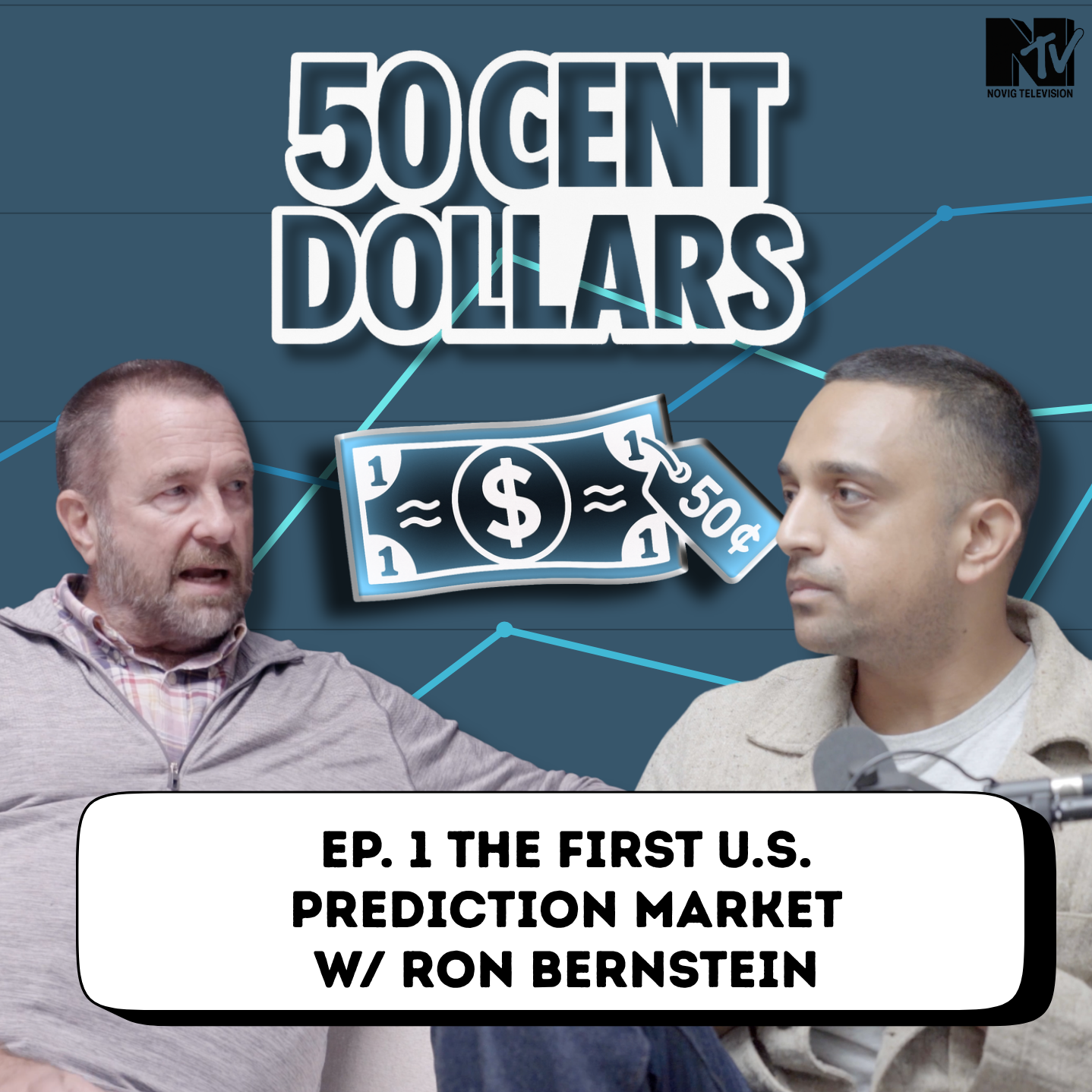
[00:00:15] Speaker A: Hello. This is the first episode of a podcast I'm recording. It's called the 50 Cent Dollars Podcast. And it's just about prediction markets generally.
I believe that after studying the history of markets and especially futures exchanges, there's so much history to be told about what has happened with prediction markets early on, the early predecessors and how what has happened to them maps to what we're seeing today. And for the first episode, can't have a more perfect guess. One of the forefathers of prediction markets, Ron Bernstein, he created or founded in trade in the early 2000s. And I am really honored to have him here as a guest to talk about the history of prediction markets and how that might map to the future.
[00:01:09] Speaker B: It's great to be here.
Your blogs and tweets caught my attention as the space started to blow up again. And I really appreciated the writing. And if I remember correctly, I reached out to you and I said, good job. And you know, that's how we got to meet a couple of times. And so it's just incredible to think about this 25 year journey.
And it came to me the other day and maybe the tweet was, or the post on X was a little boomer, but I said something like the same people who know what Labubu is but don't know what Beanie Babies are probably never heard of in trade and trade sports. So it's like, yeah, 25 years ago and now it's.
[00:01:51] Speaker A: That's a great allegory. And I think like the people say, you know, history doesn't repeat, but it rhymes. And that's what I want to dig into here. So, you know, take us back to the founding of in trade around 1999. What inspired you? You were a floor trader by profession to start a prediction market platform. Did, did you have any idea it would be as big as.
[00:02:16] Speaker B: Yeah, so a couple things and some backstory about that. I was a floor trader. I traded options on commodities for many, many years, probably 30 years.
And the trading floor was that raw, emotional trading, person to person trading.
You would actually look at the guys that you were trading with to consummate the trade. They could have been brokers or trading for themselves, but that was peer to peer. Like that was person to person trading.
And in that Time in most of the floor pits, certainly when March madness kind of got the heat going.
February, March time frame, people were trading 0 to 64 NCAA brackets.
And so that was on the floor. And people would walk around trading these futures contract 0 to 64 with the team that won the tournament, got 64. And you kept track of your trades with other people that you know and you wrote it down and you know, they had to pony up and settle at the end. And so I was a toy collector and I had built a business called gomainline.com we had a quick exit on that was okay.
But I love that startup kind of founder mentality.
And there were some folks on the trading floor, two brothers, the McNamara brothers and another guy, Greg DiPietrus. And you know, all this stuff is I think pretty fairly told in Wikipedia and a lot of the media articles about the founding of Intrade. Three good articles. You can see them on the intrade.com website, they're linked to it.
And the idea was, hey, why don't we trade sports like future?
Why don't we trade sports like stocks? And so I jumped at the chance to write a business plan.
The guys liked it and we decided to found a company and I agreed to move to Ireland for a couple years, which we had some connections to Ireland and the route there was the fine X in New York where they traded dollar products and things like that. Was opening a satellite office in Ireland. Ireland had a development grant opportunity. They were welcoming to the business.
We decided to move to Ireland and operate this business in Ireland.
Raised about 13 and a half million to operate this business. And the idea was to trade sports like stocks, but to trade sports like futures contracts.
And that was where it started. And so I moved with my family, two and a half year commitment to live in Ireland.
An unbelievable, fantastic experience. Very much like Harry Potter for the kids. They went to a school in Ireland and had blazers and they had a house and representation and stuff like that. My daughter learned how to Irish dance. My son was pulling pikes when he was, you know, 8 or 9 years old. And amazing experience.
And we put together a group of about 15, mostly developers and we built this platform called intrade.com and we started listing all kinds of political contracts and sports contracts and anything that you could resolve with yes or no.
[00:05:44] Speaker A: So it sounds like it kind of the inception was about sports and it seems like that's kind of the original thing. But you soon saw an opportunity for non sports prediction markets. And there was this split between trade sports. If I Recall correctly. And in trade.
[00:06:04] Speaker B: So in trade was first.
[00:06:05] Speaker A: I see.
[00:06:06] Speaker B: And so the categories were, you know, perceived and users were so different between the two. The sports guys just wanted sports content and everybody else wanted to understand the power of the wisdom of the crowds. And so, you know, there were a couple major elections, 2004, 8 and 12, of course, big, big elections.
But that idea where you could hedge away whatever risks you didn't want to have, whether it's this one becoming, you know, president or this law being elected, and take on the risks that you actually wanted to add. And that was the idea. And so, you know, trading is becoming ubiquitous. I think, you know, you see that in crypto as well.
And so trade anything, you know, became the mantra.
[00:06:51] Speaker A: Yeah, that's.
That's awesome. So when you guys created Intrade, did you feel like there was a lot of excitement around the idea about betting on politics?
[00:07:03] Speaker B: So the, the bookies in the UK and in Ireland, they were making markets in presidential elections and local elections. Right. That wasn't new. And, you know, you can look in the history of political betting and there is a history for it, but to make it accessible, this was very, very new. And that's what in Trade did. It took this content that previously wasn't really well documented and well measured and tracked, and it really put it in the forefront. And people start to understood that the results of these events, elections, were really, really important. And the predictive power of these markets could sometimes be even more important than, you know, what the number was. It's the predictive power. Where is this trend going?
[00:07:50] Speaker A: Yeah, and I relate, because that's how I got into prediction markets. It was all about what is going to happen with this election in 2020. And that was just my first step. And so I relate to that. But it's also, you know, I find it a very interesting corollary. Like, right from the beginning, it was just like sports and everything else kind of dichotomy. And now we're just repeating that Kalshi got in the game with the everything else part and now is bringing in sports. And to be honest, at the moment, sports is the vast majority of volume and fee revenue for Kalshi and. And it is the moment, but I do have a dream or aspirations that sports is just one of the many things that prediction markets can serve.
[00:08:39] Speaker B: Yeah, so that's a great point. I think sports are important and they are probably the training ground and the entry point for people to understand the power of these markets.
The aspect of making a bet before the Game starts one thing, but the ability to modify that bet while the event is taking place, no matter what the event is, is the new thing. Right. And so sports is the training ground, is the most ever refreshing content. There's a game or an event or something going on every day in that world that's going to bring a lot of people into, hey, my wife might like to have an opinion about who's going to win Love island or something like that. Right. And so I look at sports as the gateway to this ability to hedge.
[00:09:27] Speaker A: All this stuff on the ability to modify your trade.
According to my analysis of trade data, the vast majority of volume for sports on Kalshi is happening during the game. That part of the product I think is significantly differentiated. And then also what you just mentioned about reality tv, Kalshi is getting into that game now too. And, and I think it's the way I see it is like, I think sports is the entryway, but also from a business perspective, like going to subsidize all the other stuff, like Kalshi's gonna make a bunch of money off of sports, but then they're gonna spend a bunch of money on liquidity and volume incentives for the other stuff. And it's very similar to kind of like how college sports works where all the money is made off of the football and basketball teams and they use that money to pay for the, you know, gymnastics team.
[00:10:16] Speaker B: Yeah, the library is.
[00:10:17] Speaker A: Yeah, the tennis. Yeah, exactly. Yeah.
So, yeah, I think that dichotomy is very interesting. But you know, going back to the history of in trade, can you take me back to like the early days and you know, 2000, 2000 to 2005, where in trade was starting to get, you know, traction. And then in 2005, CFTC sent you its first kind of regulatory action against in trade, which is a cease and desist.
[00:10:44] Speaker B: Yes.
[00:10:44] Speaker A: And how did that go down?
[00:10:45] Speaker B: So my commitment with in trade, certainly to have moved my family and live overseas in Ireland, it was a two year commitment and I ended up staying three years. The company was doing okay. We were properly funded at the time. We were growing. I think when I left we had 30 or 40 employees.
A lot of it was customer service. And you know, we had a very, very good development team, built our own tech stack.
All that stuff was pretty good.
And when I left, the manager of the company was the ex CFO of the company.
And there's, as I said, good articles that are linked to this that document all the gory details. But John took over the daily operations of the company and he had his own operating.
[00:11:30] Speaker A: John Delaney.
[00:11:31] Speaker B: John Delaney.
And so the 2005 action came when there was an effort by in trade and trade sports probably to start to list more and more content, more things that are tradable, to try to increase volume and stuff like that.
Uncertain regulatory environment.
Some of the predicates were like, well, you can walk down the street as an American tourist in Ireland, walk into a betting shop and make a bet. The condition of the Internet at that time operating as a company in Ireland with no problems operating there.
Why is it any different if an American comes to that establishment in, in Ireland, even though the transport was the Internet to do that and make a bet, it wasn't American. And so there were differences as a US citizen and I had infrastructure in the United States and you know, my liquidity and my family and all that stuff way, way too hot for me.
So John had made a bunch of decisions to expand the marketplace to be an international trading exchange. And the consequences were the CFTC took umbrage at that because there were so many US participants that it was the majority. Yeah, the majority by far. And I'm sure we had CFTC nom de plumes on the membership roles. And KYC was not as crazy.
If anything, the gatekeeper was credit card deposits and banking. But it wasn't like sign up and participate.
And so the cftc, you know, took an action, company agreed to settle, paid the fine. And then it feels like, and I wasn't involved in these decisions, but it feels like continued to do what the CFTC said not to do.
[00:13:22] Speaker A: I can think of a very modern corollary to that. And Polymarket where it's so interesting. This like the way the history rhymes. It's like so early 2000s, the Internet was like kind of new. Browsing the Internet in a web browser was like this new concept. So this analogy you drew of like, oh, if an American flew to Dublin and then made a bet, that's fine. So an American can fly to Dublin through the interwebs or the, the Internet mega highway or whatever. And, and it's the same thing. And now it's so funny like that today. That's like patently like a ridiculous claim, like everyone, everything's blocked, everything's geofenced. Um, and.
But now like the modern equivalent of that was like Polymarket, hey, we're on chain. It's like not very governable. And then the CFTC took action against them, find them. Polymarket paid the fine and then Polymarket just continued to operate you know, with a nominal like vpn, like, hey, don't sign up if you're American, wink, wink.
[00:14:23] Speaker B: Right, right. And, and so like, you know, that regulatory arc of the Internet and then of prediction markets, as you said, history rhyming, like crypto suffered those things as well. 2014, 15, 16, ICOs, and you know, how those businesses tokens and securities laws and you know, exchanges and is this illegal trading, like, that regulatory arc is very, very similar.
And interestingly, I think what we see in 2025 in the political environment, right, you have a world that's 50, 50, right. Half the people, like, half the people don't like half the people red, half the people blue. That's the toughest environment because it's not obvious what the majority really wants. And so when the regulatory arc is pushed by political interests, then the politics that sway at the time, sway regulation, obviously.
[00:15:18] Speaker A: And so, you know, ironically, a great use of a hedging market for her.
[00:15:26] Speaker B: You think, hey, that solves the problem. But, you know, where political content was deemed not to be in the best interest of the American public, which was an edict by the cftc all of a sudden. It's fantastic, right? What changed?
[00:15:41] Speaker A: You know, when I was, when I was working at Kalshi, I.
I didn't like, formally suggest this, but I was thinking to myself, why don't we just buy a ton of Kamala shares?
Like, because it's like, very. To me, it was plainly obvious that if, like, if Trump won, we would get a more friendly regulatory environment. I didn't, I didn't know to what degree that it would be like. And the way it is right now is actually far beyond what I would have forecasted a year ago.
But, like, I knew that Trump winning would be good for Kelshi and so that we should hedge by like, buying millions. Yeah, but we obviously didn't do that. I'm just, I was just, you know, thought experiment, as I tend to do.
[00:16:29] Speaker B: Those hedges are unsatisfying because you don't want that outcome to occur. But, you know, it's. It's a little band aid, I guess.
[00:16:36] Speaker A: Yeah.
Okay, so now let's talk about that 2005-2012 period where I think with each successive, especially US general elections, that seems to be like the bell of the ball, the star.
Each successive election in trade's profile continued to grow and then ultimately culminated with the 2012 election between Barack Obama and Mitt Romney, where Intrade did a phenomenal job forecasting getting 49 of the 51 jurisdictions correct.
Coming I think it was one electoral vote away from the final tally. Incredible.
[00:17:15] Speaker B: Yeah, amazing. Like, this was the proof that these things, these prediction markets actually had some value. Right.
All the, you know, the kind of academia who were supporting prediction markets for all this time, you know, many of them now becoming more vocal, you know, they were right. And now they, you know, started to have a standing and say, hey, look at the data, look at the data. You know, this is true, this is what's happening.
And so that was really, really beneficial.
Except it bothered the wrong people.
[00:17:48] Speaker A: Yes. So a few weeks after the general election in November 2012, what happened?
[00:17:54] Speaker B: Yeah, so let me, let me back up about six months or something like that, because in 2011, for whatever reasons, and this is kind of an area I don't want to talk too much about, but John Delaney, who was operating the company, had raised another successful round of fundraising back in 2006. Seven, eight, sent correspondence to the CFTC, asked what it would take to become regulated. You know, didn't get any satisfaction or he didn't like the response.
Fast forward a few more years.
I don't know the history, it's personal, it's kind of sensational, it's not really business oriented.
But he decided to attempt to climb Mount Everest. He was a climber. He had climbed, you know, three or four of the largest peaks in Europe or around the world previous to that. Wasn't an experience, but he decided to climb Mount Everest. And the sensational part of the story is that he died climbing, hit the peak, couldn't come down, passed away. And so 2011, he was already a little antagonistic and antagonized by the CFTC and questioned his status about visiting the United States and things like that.
But when he passed away, I was still the largest shareholder of the company and so I wanted to understand what was going on. It looked pretty good. The volumes were there, the news and the publicity was pretty good about in trade awareness wise, came back to the company, tried to get things organized and I was greeted with illegal action by the CFTC. And that was in 2011, 2012. I don't know the exact time frames, but it was right when we were trying to figure out how to get this thing going again. It was too good to ignore, to leave alone, to let it die and wither away.
Information was proven to be really valuable.
[00:19:50] Speaker A: But that for the same reason it was too good to ignore by the cftc. They couldn't just like turn the other cheek anymore.
[00:19:58] Speaker B: Yeah.
[00:19:59] Speaker A: And especially after the 2012 election where it was A hot.
[00:20:02] Speaker B: Yeah. And some of the scientific analysis about the election, the Romney well story, whether or not someone was trying to use, you know, too much money to influence the markets in a way that would actually influence the outcome of these elections, the CFTC said, no, don't do it. And so that put the final act of in trade at that time.
[00:20:27] Speaker A: The beginning of the end.
[00:20:28] Speaker B: Yeah, beginning of the end for sure. And so what became of it was trying to defend in trade from the cftc.
I became much, much more active in trying to reorganize the company in a positive way and the books and records of the company didn't quite add up. And so that took us down a different effort than we had expected.
[00:21:00] Speaker A: Are you willing to say more about.
[00:21:03] Speaker B: So let's say when the CFTC is a very insular, strong leader, doesn't really take a lot of counsel or guidance from others.
They have lots of power located in a very, very small area.
The record keeping was not great and the money didn't add up.
And so we had to fight that issue.
The law in Ireland was, as a director of the company, if you know that you are trading insolvently, you. You become liable for any further liabilities or potentially all liabilities incurred by the company.
And so my first rule of the last number of years that I've been doing stuff is I don't want to go to jail.
[00:21:55] Speaker A: Right.
[00:21:56] Speaker B: And so the first thing that I did when I took formal control of the company again as a lead director was cease operations and inform customers. We don't understand what's going on. Bear with us, we're going to figure this out, but we need everybody just to, you know, settle down and we're going to try our best to get your money back.
What ended up happening was we reached a settlement with the estate of Delaney, who had passed away on Mount Everest.
Very legal.
I wouldn't say was amicable, but it was obviously the thing that needed to be done for all parties involved and we were able to repay everybody's customer funds and then figure things out.
In 2013, the company focused its efforts on trade sports and tried to return to the marketplace as a fantasy sports contest place.
[00:22:49] Speaker A: So, you know, with. After John Delaney's tragic death on Mount Everest, then the CFTC's action and with the regulatory pressure and this internal financial mess, it sounds like this was a perfect storm.
If the CFTC hadn't acted, do you think like the company would have survived the Delaney stuff, the death, or, or not?
[00:23:13] Speaker B: Yeah, I do.
I think it was The CFTC that prompted the concerns and maybe some of the actions that Delaney had taken.
He was very, very focused on making the company successful. He had entertained offers by others to buy the company. Who, you know, saw this happening? I think Nadex was in the background trying to, you know, begin an event futures platform licensed and regulated by the CFTC in the US and so this space was happening, it was going to happen. And then you saw weather derivatives and you saw other kind of interesting hedging projects on products on various exchanges. And so, you know, the notion of risk besides like, you know, gold, silver, copper, cotton, you know, it started to expand. And so event derivatives became a thing. And that was important.
I think part of the problem was, you know, the regulatory barriers in the United States, where most of the customers were, were too difficult to overcome and the route to overcome them wasn't clear earlier and they were changing.
[00:24:19] Speaker A: Yeah. And I think, you know, modern day, like so much of the quote, unquote, innovation that is occurring is the. Is the way operators have navigated the regulatory waters. And something that maybe could have happened in 2012, but it didn't. And then it happened in 2022 and then 2024, and now we're here.
[00:24:41] Speaker B: Yeah. And that, that parallel in crypto, what, you know, was very, very difficult, uncertain, cloudy in 2015. 16 ICOs, securities, not securities tokens right now, like DATS. And, you know, all this stuff is just what's different.
[00:24:57] Speaker A: Yeah.
[00:24:57] Speaker B: Background, political environment, what else?
[00:24:59] Speaker A: Yeah. So after in trade shut down in 2013, tell me a bit about where you were at personally. You know, this project had failed and you were thinking, I'm sure, like, okay, what are the next steps and what were you trying to do with your career at that point and how did you end up in the crypto world?
[00:25:19] Speaker B: Yeah, so there was a pivot there in trade, you know, taken it shot, we shut it down, went bankrupt. Because of the CFTC action, we didn't have enough money to pay the fine. I think it was a million or a million and a half, I forget. But we didn't have any money.
And trade sports was still active, but not operating at the time. The technology was still good.
Fantasy sports in the United States started to take off.
And so we thought, well, maybe a trading contest would be interesting. And we tried to reorganize trade sports as a trading contest.
Ten people would enter a contest, pay $110, we'd have 1100, we'd pay out a thousand in prizes. Whoever traded the best won the contest. And so it was a nice model, naive model, but it didn't really catch on.
And so, you know, 2013, 14, with the funds and the company dwindling down, I got approached by a guy by the name of Joey Krug, who was one of the founders of the Augur Protocol.
And I consulted with Augur for a time and then ended up forming a company called Augment Partners.
Now, this was kind of my first real form into crypto, but prior to Intrade and Trade Sports fully shutting down, one of our larger trading customers asked if they could deposit Bitcoin to fund their account.
And we didn't really know what it was, but we learned about it, and we said, sure, we would do that.
And immediately we saved 3.5% on customer deposits.
So the world of online sports betting, for lack of a better category term, you know, credit card companies really have a tremendous amount of power and authority. And so we needed an arrangement with credit cards so people could impulsively put 50 bucks down and participate. Well, every deposit cost us 3.5%, and it took us a while to get that money back. Obviously, it was worth it. Right. You have to get a customer to try the experience and decide if they love it. Most of them do.
But it was expensive. The first time we accepted a Bitcoin deposit from this large customer, we converted immediately into fiat.
The proceeds we got to the penny were deposited into, and this was bookkeeping entry into the customer's account. And we just saved three and a half percent.
And so it was fantastic. And that kind of took me further down into the crypto syllabus. Right. I wanted to learn more about crypto. And so 2014, 15 time frame, Augur approached me and inbound Joey said, hey, you know, love what in trade was and prediction markets. We're building a version of that on the blockchain. Could you consult, talk about it? And that ended up an agreement where I did some consulting. We licensed Tradesports Technology to Augur to be useful.
Our consideration for that was rep tokens.
We started buying and selling other crypto tokens based upon that, kind of like a little briefly.
[00:28:50] Speaker A: Can you explain what rep token is?
[00:28:52] Speaker B: The rep token was the ICO token for the Augur protocol.
The basic use of that token was to be part of a staking equation to resolve disputes.
So you would use these tokens to stake more on the outcome you thought was a legitimate outcome. And. And there would be, like, a bidding war to determine who has the most financial impact based upon the result of this and is willing to stake on that. Opinion more and more money if it's confrontational.
And so we'll probably jump to this later in this particular conversation. But contract resolution and contract descriptions is still one of the remaining kind of aspects that needs a little bit more.
[00:29:41] Speaker A: Finesse and that a lot, a lot.
[00:29:45] Speaker B: And that is going to come to a head the next few times. Big outcomes, you know, are swayed by, oh, I didn't really understand that. Or did they mention it four times or five times or they spelled it with two Ls instead of one L.
[00:29:59] Speaker A: Was there a hyphen? Like I dealt with this at Kalshi. It was, it was, it was rough and we're. I kind of think like this is maybe the hidden ticking time bomb of prediction markets where some not obvious non sports market gets really big and there's a rules issue to the tune of millions of dollars of open interest.
[00:30:26] Speaker B: Go back to Santorum Romney. Right?
[00:30:28] Speaker A: Yeah. So this is great piece of prediction market history and lore I learned when I was researching for this one of the original and I hate to, I mean I don't hate to, I like, I think the word is funny but it is unprofessional. But the word is rules. Cuck. One of the original rules cucks in prediction markets was, I think it was the Iowa primary versus it was Romney versus Santorum or Romney versus the field but the media had originally called it for Romney. And then after all the counting was really done, especially with Iowa's like weird like caucus system, it ended up that Rick Santorum won by a very narrow margin. And so from what I understand what happened, the rules of the market were about what the media reported, not what.
[00:31:17] Speaker B: Three out of four reputable media sources.
[00:31:20] Speaker A: Yeah. And so this reputable media source or aggregation of news or this kind of reliance on this is like such a fraught thing. And so like while we're on the topic, tell me a bit about, you know, what happened there, how did Intrade deal with it and like what was the lesson learned?
[00:31:40] Speaker B: Yeah, I'm not sure actually. I just want to be honest, I wasn't involved in the resolution or anything but I did know that it was controversial.
The other area of controversy was these war markets and assassination markets and you know, they, they're fact of of life. The circumstances of those things do occur. Whether or not they're going to happen, there are odds for them. Do people want to trade them? I guess some weird people really want to trade them. Do they have impact in the world? Yes, they have impact in the world. But do I really like Those markets, maybe not.
[00:32:13] Speaker A: Yeah, I think it was at some, while you mentioned there's at some point in the, in the 2000s there was these DARPA like funded war markets and, and it created a huge uproar where it's like betting on terrorism. Like, how could you do that? And now like war markets, especially about Russia and Ukraine are very popular on.
[00:32:36] Speaker B: Polymarket, Israel, Yemen, strikes.
[00:32:38] Speaker A: Yeah, exactly.
[00:32:38] Speaker B: Yeah. And, and so they're happening.
[00:32:41] Speaker A: History rhymes. Yeah.
[00:32:43] Speaker B: You know, and that stuff is fraught with potential insider trading. Like you wonder whether or not the heat associated with those markets is more important than the bad reputation that the marketplace in general is going to suffer from.
Maybe now is not the right time. Maybe when surveillance and proof and truth is more well defined.
That's not the low hanging fruit, but that's very sensational.
[00:33:11] Speaker A: Yeah, I think that's a great point you made in that there is has to be a bit of like strategy on, from prediction market platforms to.
It's like you want to, I think you want to ease people in.
[00:33:25] Speaker B: Right.
[00:33:25] Speaker A: If you, if Kalshi just started putting war markets on Robinhood, like it would be too much too fast. It's just. But at the same time, these platforms are all competing with each other and the way they're going to compete is by stand out. Yeah, exactly. So this striking, this balance is going to be something I will be watching very carefully and intently like over the next couple of years as this industry develops. But yeah, just getting like people warmed up to the idea of betting on anything. And then, I mean, I don't, I'm personally not advocating for like war markets or that that should be a goal of Kalshi or polymarket or, or anyone. But if, if that is going to happen, like, I would recommend taking things slow, you know, like already, like what will someone say on south park is like already kind of risque in a way because of just of it's so out there.
But anyway, so yeah, there's fascinating history of, of rules issues and war markets in the 2000s. But coming back to crypto, you were heavily involved in Augur, and then what happened?
[00:34:34] Speaker B: Yeah, so, so at, at Augur, we formed a company called Augment Partners.
We raised some money for that company. We had great investors, very crypto savvy investors. Some of the biggest names were participants.
And our mission was to build things on top of Augur. Our first product was meant to be an Augur explorer. And so that was how we would prove to the world that the results that they, the contracts that the funds Involved transparent blockchain, open. You could see what was happening.
Then it would be building an agnostic front end. Anybody could participate from different locations.
And interestingly, all that stuff from 2015, 2016 is exactly what is exploding right now in prediction markets. It is this collaboration composability.
Like everybody doing little things with the APIs and with the mentioned markets and arbitrage tools and all this stuff. And so that's the thing that crypto really enables. And that was what was so exciting and became more exciting. And so Augur took a little bit longer than we had expected at Augment Partners to harden the protocol and it did launch, but it never really.
[00:35:54] Speaker A: I think liquidity was an issue.
[00:35:55] Speaker B: Liquidity and it was hard to understand and use.
[00:35:58] Speaker A: I remember going on Augur and being like, this seems really scary. A complicated, like weird UI and then also empty, like a barren.
[00:36:09] Speaker B: The users weren't quite ready. Like if you had to set up a metamask wallet and the seed words and all this stuff, it was just like, wow, this is so much hassle, I'd rather just place a bet. And so it took a little bit longer. And so my personal journey at that time we were expecting experimenting with off chain order matching on chain settlement. And that was a Zero X protocol was kind of sponsoring that.
Augment Partners received a grant from 0x and we built a dex called Paradex. And so that was our thing. We would want it to run a really fast like professional trading Dex where we.
[00:36:51] Speaker A: Dex meaning decentralized exchange.
[00:36:52] Speaker B: Decentralized exchange where you know, you can participate by having a wallet, connecting, depositing into a smart contract.
[00:36:59] Speaker A: But by taking the matching engine off chain, you improve performance.
[00:37:02] Speaker B: We improved performance dramatically pre salana and all that stuff. And so it was, you know, really, really fast. Like you couldn't tell. And Transport's technology was really good, really, really good. We had a fantastic technology team.
And so Coinbase saw that aspect and some of the folks in Coinbase really saw the power of decentralization and what was coming.
And defy and Coinbase made an offer to buy Paradox that it was too attractive not to accept. And the participants in the company wanted to do it, the investors approved it. And so that's what we did. And so we sold Paradex to Coin Coinbase and the team moved over to Coinbase and became Coinbase employees.
At that time, kind of, you know, progress stopped on Augur.
They tried to do a little backfill and stuff like that and they still had the use of the technology, but it never really rose to the, the prominence that it could have and, and might even. Augur is still active, by the way. And I know that there are, I would say, brilliant technologists pushing that project forward, and I don't think it's over yet.
[00:38:17] Speaker A: Oh, that's great to hear. I think I'm looking forward to seeing what they do.
[00:38:22] Speaker B: Yeah, they're brilliant.
[00:38:23] Speaker A: So what ended up happening at Coinbase?
[00:38:26] Speaker B: Yeah, so, you know, Coinbase and thinking about the regulatory arc of crypto and of, you know, trading and exchanges and regulatory environment.
Love the idea of a Dex and they're triple, quadruple, quintuple, down with bass and everything that's happening on that ecosystem.
[00:38:45] Speaker A: Yeah.
[00:38:45] Speaker B: But in 20, 19, 18, 19. It was too early. It was too early. And we got there as employees, like 210 to 220, and we were told, you know, can't offer this to American customers. The regulatory environment isn't clear.
Short period of time after that, we had to shut down. And so the company was very enthusiastic and very supportive and very generous in its acquisition of the company, but it didn't have a roadmap past a couple of months. And so that became a pretty difficult situation.
[00:39:21] Speaker A: And so did the shutting down of Paradox eventually. And in you departing from Coinbase.
[00:39:28] Speaker B: Yeah, I was with Coinbase for a couple of years. I think Coinbase is absolutely a fantastic steward for crypto and, you know, user introduction.
I also think the company is very, very, very well run. I think they have an incredible focus on security and on running a business properly. I love the, you know, mission forward aspects, the hidden that they've taken to get where they are now.
Tremendous.
I felt my personal journey there wasn't all it could have been. We had some opportunities to try some other things, but this was a company, you know, that now has 5,000 or more employees, only your employee, 200 or so. Yeah. It's hard to get the attention that you want for the ideas that you think are going to happen next.
And there's a lot of competing ideas for the resources. So the company is what it is. It wasn't a super satisfactory experience for me, but, you know, we were treated very fairly.
[00:40:37] Speaker A: Yeah, yeah.
So.
But there's. So there's another story chapter to your crypto story with Ethereum, Correct?
[00:40:45] Speaker B: Yeah. So for Tradesports, which was the entity that funded part of Augment Partners and Trade Sports, owned the technology that we licensed to Augur, we received a bunch of rep tokens.
[00:41:00] Speaker A: Oh, I see.
[00:41:01] Speaker B: Yeah. And so we took those rep tokens. Yep.
[00:41:04] Speaker A: And we converted that's the trade of a lifetime.
[00:41:07] Speaker B: That was a trade of a lifetime. We converted a lot of it into Ethereum.
[00:41:11] Speaker A: Wow.
[00:41:11] Speaker B: The relative prices at the time were like, I think augur's ICO was $0.50 or $2 or something like that. Really, really low. And eth was 5 or 6 or $10.
[00:41:24] Speaker A: Yeah.
[00:41:25] Speaker B: But we had, you know, a lot of zeros in the number of tokens that we had.
[00:41:29] Speaker A: I believe you.
[00:41:30] Speaker B: So, you know, we trade them and bought some more and sold some of this and bought some of that and we built up a really, really decent treasury within Tradesports Technology holdings, which was the company that licensed out the technology.
And so that aspect did very, very well. And it wasn't a digital asset treasury, but we ended up with all these tokens.
[00:41:53] Speaker A: Yeah, I have some of my own. I'm only, I'm only 29, so I don't have that much personal lore, but I have just a funny anecdote, like the opposite of a trade of a lifetime. When I was 16, I actually used Coinbase to buy two bitcoins because I was trying to buy weed on the dark web. And, and then I bought it and then I was like, oh, shit, this is like actually way too scary. I, I'm not, I'm not gonna do this. And I remember back then you had to like, I had to drive, I just got my driver's license. I had to drive to cvs and like moneygram.
150 bucks to like some random. And then it would appear. And so what happened is like, I bought these bitcoins around $90 each. My God, like now I'm like, oh my God, I'm so stupid. But. And then I sold it for like 110 and I thought, wow, cool, 40 bucks. Especially as a 16 year old. 40 bucks was kind of nice.
But yeah, that's the total opposite of, of what happened with you and Ethereum.
[00:42:55] Speaker B: Yeah, well, I, I had similar experiences. I think I, I bought bitcoin at Walmart. Money Grand. Yes, something like that.
And I'm sure I had multiple wallets with, you know, 30, 40, $50 bitcoins in them just to try out all the different wallet experiences. Those computers were trashed and stuff like that. Like, I feel for the guy whose computer is at the bottom dump. Yeah. You know, raised 30 million to try to extract it. Yeah.
But, you know, that was an incredible journey. Tons and tons and tons of learning took place at that time. And so it was actually a very exciting time.
And so I think where we left off, I left Coinbase. You know my personal story, I left Coinbase.
We had a fantastic interaction with Zero X when we built Paradex. I think Zero X is one of the top teams in crypto and I absolutely love those guys and the experience there at that time, the arbitrage opportunities and liquidity wasn't good enough on chain. And so the idea that Zero X had was maybe we can instigate a trading desk that can add 0x liquidity to participants. And so our job at the trading desk, very naive strategy. Look at the markets on Coinbase, Binance, what happened ever and use the 0x protocol to replicate that liquidity so that people would feel very, very comfortable they were getting a good price on chain.
We operated that business. I think we had a team of seven or eight. Fantastic opportunity again, great team.
All those, you know, people have been very successful afterwards as well as 0x just continues to kill it.
Mev became a thing and so we lost our edge and that kind of naive strategy wasn't good enough. And I retired.
[00:44:57] Speaker A: Oh, you should put it so frankly. Sorry, but, but yeah, I think that's a, I mean it's such a, it's such a cool story like you know, being involved in market structure innovation from, for, you know, over two decades and there's just so much to be learned from that and to carry forward as market structure innovation is now in a whole, it's kind of in a new era. And so I was wondering how you feel like, for example, what do you think it would take for prediction markets to, to go truly mainstream?
[00:45:35] Speaker B: They're going mainstream, there's no doubt about it. It is. You know, the fire is there, the accelerant is there, the demand, the interest is there. You can see it.
What's amazing about it is the regulatory environment is friendly to it, the regulatory environment is friendly to crypto. The advantages of decentralization, of transparency, of self custodianship, of novel collateralization, of margin trading, of all of the stuff that's so interesting on crypto and less risky from a protocol perspective, maybe more risky from a scam perspective at the moment.
All of that is being applied so freaking fast to prediction markets. And so there's probably very little life, this is my personal opinion. There's probably very little life in a prediction market that tries to ignore Web3 right now because of all the advantages Web3 will bring to bear. Capital, efficiency, composability, novel game strategies, novel risks, novel trading markets, conditional markets.
It feels like almost a perfect storm. Crypto prediction markets slash user interest and Awareness without the downsides of this is stupid. Like, there is no. Nobody can say this is stupid. It's not stupid. This is important.
You want the risks that you want and you want to get rid of some risks, and this is a way to do it. Or it's fun. It's fun to trade, it's fun to watch tv and oh, man, I can't believe I just missed that one.
[00:47:18] Speaker A: Or.
[00:47:19] Speaker B: Yeah, I just wanted Jill to win this, you know, Love Island Bachelorette. Yeah.
[00:47:24] Speaker A: Like, yeah. So I appreciate your, your web3 perspective and the take that, like, things are going to. That web3 might win. Prediction markets. It's interesting. So, because I'm so.
From the regulated space. I was, I was on Predict it and then I was. I worked for Kalshi and, you know, that's working. My, my interpretation of the current landscape is like, regulation is the key to unlocking distribution, and distribution is the key for order flow and order flow is the key to liquidity. That is the entire. That's how all of this works. The Kalshi Robinhood partnership is the most important relationship in prediction markets at the moment. It's very clear. It's borne out in the data. It's just, it's so obvious. And so now we're in this environment where the regulators are, you know, very quote, unquote friendly.
They are letting a lot slide. Crypto is also making a lot of advancements in the regulatory space. So I can, I can imagine, like the regulation is what enabled the huge distribution that Kalshi has achieved through brokers. And the crypto stuff enables a huge design space of market structure.
Now that we have like all these efforts with the Genius act and the Clarity act coming soon, a lot of like, crypto is going to integrate itself more into the TRADFI system. And so this is going to mean a huge, maybe explosion of like, design space for tools, market structure, funding, collateral.
As we, if, if prediction markets are able to combine the traditional structures that already exist that enable national and global, actually global distribution to crypto.
[00:49:25] Speaker B: Yeah. So, so I think back, you know, this is kind of like, you know, boomer and, and going backwards, but when I first use email right now, let's say, you know, I know this is trite to say, but the Internet is ubiquitous.
[00:49:38] Speaker A: Okay.
[00:49:40] Speaker B: Crypto will become ubiquitous. Right.
So when that happens, it won't matter. And if you don't embrace the capabilities that crypto brings to bear, you will not have all of the functionality that you need to be successful. Wow. Yeah. I just think that's it like the Internet, it's ubiquitous. Right. You're not participating in the world if you don't have Internet access. There's just more information. Think about what's going on with AI right now. Right. Like the amount of extra information, extra knowledge, shortcut and development cycles, all that stuff. If you don't have crypto, you will not be competitive.
[00:50:20] Speaker A: Wow, that's a great sound bite, Cliff.
Looking at your history, I think you've been remarkably persistent in your entrepreneurial approach to markets.
Creating in trade, trade, sport.
Seeing that through unfortunately didn't work then. Getting into crypto and exiting and doing very well for yourself.
Now you mentioned you've retired and you're kind of watching from the sidelines now. But I was wondering, as someone who's been through that and especially over a multi decade career, what advice would you give to people who are kind of getting into it and maybe thinking about building in the space and, and being an entrepreneur in either prediction markets or markets in general as this space seems to be exploding and so rich with opportunity.
[00:51:14] Speaker B: Yeah, so, so I think one of the things that, that rings true to me is based upon my history of floor trading. And so, you know, I first started out as a clerk in the, you know, for a gold trader.
And at the time there was an arbitrage between the New York market and the Chicago market and maybe it was 70, 30, New York versus Chicago and within two years it became 95, 5 or 99, 1. And so marketplaces tend to have a dominant winner based upon the best liquidity or the easiest to use or the most flexible rules or the most innovation. And I think that is probably likely to be true for the dominant marketplace in prediction markets. Right. These are just another market.
Whether it's politics or crossing the street or entertainment TV or whatever. They're just other markets. Right. Mentions, whatever. Some of them have a lot of significance, some of them don't. They're just entertainment, totally fine. Entertainment's fantastic. Like human beings need to be entertained. Right.
So you know that's, that's always going to be part of it. But I think it's true that there are going to be a few winners.
I also think that there will be additional winners, but not as big, that help serve different niches of the marketplace. So whether it's a, you know, different market structure or focus on a certain kind of content, better UI, better UX. But even those better UI UX's they might be served by the same underlying order book.
[00:52:54] Speaker A: Yeah.
[00:52:55] Speaker B: And that will never know. And I Think what I'm so excited about is to see this crypto programmable money language start to take place within that where you can actually use your eth to trade. A dollar denominated co contract is collateral on margin with automatic liquidations when the market moves and stuff like that.
And you know, I, I keep thinking about all the differences and when I thought about like, you know what I can't wait to see kind of ingest.
But I want to see who's going to list options on prediction market contracts.
[00:53:31] Speaker A: So where the price, where the probability will be at a given time.
[00:53:34] Speaker B: Yeah. So who's going to win the election?
[00:53:36] Speaker A: Yeah.
[00:53:37] Speaker B: And Instead of trading 0 to 100, you're trading an option on the 0 to 100 contract.
[00:53:43] Speaker A: I think that's such a.
This is.
I also agree in that the way exchanges have historically competed is that it tends to be kind of winner take all. And, and there's a reason why CME Group is called CME Group. Right. It's because CME won a couple key products and then whenever another exchange started winning some, they just bought it, they just acquired it. And, and, and there's so much like, you know, carryover like optimization when, when you have one group kind of running a bunch of exchanges and then that advantage tends to beget itself. So I'm not making any calls or anything but like, who know, we might see that Kalshi becomes Kalshi Group and they acquire another exchange that had developed a niche. Like maybe there's an exchange that comes out and they are the best in like merger markets or something or the best at options and stuff. And so that in terms of like competing in this ecosystem, competing with like Kalshi and Polymarket and, and whomever, that's one lane I personally see. And you kind of touched on this with the crypto ecosystem of building.
As these exchanges compete with each other, the winners are going to be actually the traders and the people who are selling picks and shovels to the traders or picks and shovels to the exchanges. Right. And so.
[00:55:15] Speaker B: Or the, I mean, yeah, I completely agree. Like more likely the traders are going to get way, way better pricing than they ever would I. E With a sports book or even a sportsbook trading offering bets on politics. Right. Like the prices are going to be infinitesimally tighter, way better.
[00:55:34] Speaker A: And the incentives, liquidity incentives, volume incentives, you know, even like more abstract, Kalshi has this thing called Kalshi ecosystem now where they're giving grants to people building tools and, and I think that's A brilliant move. Smart, you know, and so Poly is doing it, too. Yeah. Yeah. I think. I think the people, the operators of the exchanges are pretty savvy. Like, it's.
It's clear that the vision is very big and that this is. They're building for the long term. Well, Ron, like, on that note, I really appreciate your time. Like, we've learned so much about from the history of these markets, and I think they will, as they have continued to, like, inform the future of the space. And anyone who's trying to predict what's going to happen with prediction markets should study the history. I think it's personally really fascinating and. And I think that's what my podcast will be about and what my blog is about. And it's just, like, an honor to have one of the OGs here, and I really appreciate your time.
[00:56:46] Speaker B: Yeah, I'm happy to do it. As I said in the beginning, I think you're writing about the space is fantastic.
[00:56:51] Speaker A: Thank you. Thank you.
[00:56:52] Speaker B: You know, we had a little bit of coverage. Now there's a ton of coverage, and it's great, and so it's hard to keep up. Yeah, there's just so much going on, and what's around the corner is super exciting. So I think, you know, now that all the stars seem to be aligning, it's going to be good.
[00:57:10] Speaker A: Yeah. Awesome.
All right. I think we're good.
[00:57:14] Speaker B: Thank you.
[00:57:14] Speaker A: Thanks, Ron.
[00:57:16] Speaker B: That was cool. Yeah, that was fun. Thank you.